# iPhone Display Grades Explained: Soft OLED vs Hard OLED vs Incell for Bangladesh Repair Shops
Short answer: Soft OLED uses a flexible plastic OLED panel and is the closest aftermarket match to an original iPhone screen. Hard OLED uses rigid glass: slightly thicker and cheaper. Incell is an LCD with built-in touch: cheapest, but thicker, with greyer blacks and higher power use. Original or refurbished screens rank above all three.
Every iPhone screen replacement in Bangladesh starts with a grade decision, and the grade decides most of what the customer sees afterwards. This guide to iPhone display grades is written for repair shop owners and parts wholesalers who need to know what is physically different between a Soft OLED, a Hard OLED and an Incell screen, how each one behaves on iOS, and which grade belongs at which price tier. If your question is whether a supplier's "Grade A" label means anything, read our breakdown of why Bangladesh shops keep getting burned by fake Grade A displays first. This post is about the construction categories that sit underneath that label.
What are the iPhone display grades?
The aftermarket sorts iPhone screens by panel technology, not by a quality score. Four categories cover almost everything a Bangladesh shop will be offered:
- Original / refurbished. A genuine Apple panel. "Refurbished" usually means a pulled original panel that has had its cracked cover glass replaced and has been relaminated.
- Soft OLED. An aftermarket flexible OLED panel.
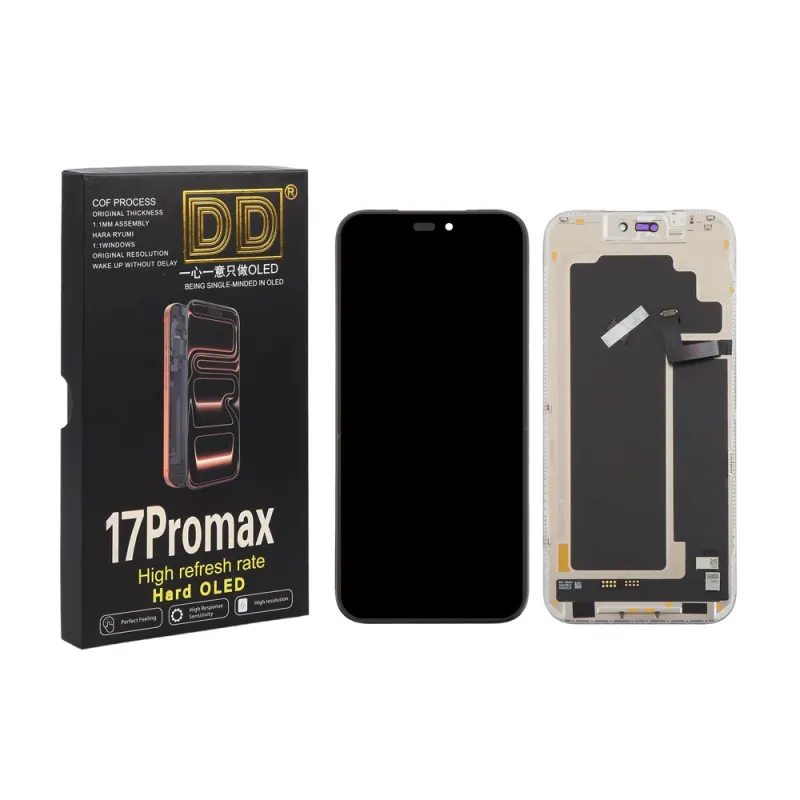
- Hard OLED. An aftermarket rigid OLED panel.
- Incell (FHD or HD). An aftermarket LCD with touch sensing built into the LCD cell.
A grade tells you the technology. It does not tell you the batch quality. Brand and batch consistency matter as much as grade.
How each grade is built
Soft OLED: flexible substrate
Soft OLED is an OLED display built on a flexible plastic substrate (typically polyimide) rather than glass, the same basic construction Apple uses in its original OLED iPhone screens. Flexible AMOLED backplanes can be built on plastic substrates. This lets the bottom edge of the panel fold back behind the display, so the module stays thin and the bezels stay narrow. Soft OLED is the grade that comes closest to original thickness, bezel width and viewing angles.
Hard OLED: rigid substrate
Hard OLED is an OLED display built on a rigid glass substrate, which cannot bend, so the panel is usually slightly thicker and may show a marginally wider bottom border than the original. It is still self-emissive OLED, so it keeps true blacks and good contrast, and the pixels switch off on dark content. Its cost sits between Soft OLED and Incell.
Incell: LCD with integrated touch
An Incell iPhone screen is a liquid-crystal display (LCD) with the touch sensor built into the LCD cell, used as a low-cost replacement for iPhone models that originally shipped with OLED. An LCD needs a backlight. That makes the module thicker, raises the black level to a dark grey, and keeps power use roughly constant whatever is on screen. "FHD" and "HD" Incell refer to panel resolution: FHD Incell has the higher pixel density and looks sharper, while HD Incell is the budget tier.
COG vs COF: where the driver chip sits
Suppliers also quote COG (chip-on-glass) and COF (chip-on-film), which describe where the display driver IC is bonded. COG mounts it on the panel glass and needs a wider bottom border; COF mounts it on the flexible circuit and allows a narrower one. When two screens of the same grade differ in price, ask which bonding each uses.
Soft OLED vs Hard OLED vs Incell: comparison table
| Attribute | Original / Refurb | Soft OLED | Hard OLED | Incell FHD / HD |
|---|
| Panel type | Apple flexible OLED | Aftermarket flexible OLED | Aftermarket rigid OLED | LCD with in-cell touch |
| Thickness vs original | Same | Very close | Slightly thicker | Noticeably thicker |
| Black level / contrast | True black | True black | True black | Dark grey, lower contrast |
| Bottom bezel | Original | Close to original | Can be slightly wider | Often wider |
| Power draw | Baseline | Close to OLED baseline | Close to OLED baseline | Higher; backlight always on |
| Colour and brightness | Factory calibrated | Good; varies by brand | Good; varies by brand | Flatter colour; lower peak |
| Typical customer | Premium, resale-minded | Mid-to-upper repair | Value-conscious | Lowest price, older devices |
Treat the table as a direction, not a specification. Batch quality inside any grade can move a screen up or down a column.
How iOS reacts to a non-genuine display
Every aftermarket grade, including Soft OLED, is non-genuine as far as iOS is concerned. Customers should hear this before the repair, not after.
The "Unknown Part" message. On iPhone 11 and later (except iPhone SE 2nd and 3rd generation), Apple shows "Unknown" next to Display in Settings > General > About when the display is not genuine, has not been verified and linked to the phone, or has been modified. On iOS 15.1 or earlier the same condition shows as "Important Display Message". Apple states that these messages don't prevent the iPhone from being used, but they can lower trade-in value. Apple's iPhone Parts and Service History page explains every label, including "Used" for genuine parts that came out of another iPhone.
True Tone. Apple warns that non-genuine displays may lose True Tone or show unreliable auto-brightness. The trade workaround is to read the original screen's data with a display programmer and write it to the replacement. Save that data before you remove the broken screen.
Face ID. On most models Face ID lives in the TrueDepth module, not in the display itself. The practical risk is the front sensor flex that you transfer from the old screen. Tear it or damage a connector, and Face ID or the proximity sensor can stop working, whatever the grade of the new display.
Battery drain and brightness. Apple lists higher battery drain, lower maximum brightness and colour casts as possible effects of non-genuine displays. These complaints are most common with Incell, whose backlight runs all the time.
Which iPhone screen grade suits which customer?
Grade selection is a pricing and expectation decision as much as a technical one.
- Original / refurbished. For customers who care about resale value, use the phone heavily outdoors, or own a current Pro model where any compromise in colour or thickness gets noticed.
- Soft OLED. The default recommendation for most mid- and upper-tier repairs on OLED iPhones (X, XS, 11 Pro and 12 series onwards). It is the closest match on thickness and black levels, so it produces the fewest "my phone looks different" callbacks.
- Hard OLED. For customers who want OLED blacks and battery behaviour at a lower price and will accept a slightly thicker module.
- Incell FHD. For price-led customers, phones being prepared for resale at the low end, or older OLED models where the repair budget is tight. Present it as an LCD: it will look different from the original.
- Incell HD. The lowest tier. Use it only when price is the only criterion, and say so on the job card.
A practical stocking rule for a busy counter is to carry Soft OLED and Incell FHD for every high-volume model and order Hard OLED and original screens on demand. See our Bangladesh smartphone repair market overview for where volume concentrates.
How to check an iPhone screen on arrival
Run incoming QC before the stock goes on the shelf, not on the customer's phone.
- Count and match the model. Check each screen against the model printed on the box and the flex shape.
- Test-connect before peeling any film. Connect the screen to a test phone or a display tester, then check touch across the whole surface, including edges and corners.
- Run a solid-colour test. Use full-screen white, black, red, green and blue. Look for dead pixels, banding, colour casts and, on OLED, uneven tint at low brightness.
- Check brightness at maximum and minimum. Compare against a known-good phone of the same model under the same light.
- Inspect thickness and fit. Dry-fit the screen in a housing to confirm it sits flush and the frame clips seat cleanly.
- Sort by batch. Label each batch by brand and arrival date so callbacks can be traced back to a batch, not just to "the supplier".
iFixit's iPhone repair guides are a useful reference for model-specific opening and connector steps when training new technicians.
Sourcing iPhone displays through a formal channel
K.H. Infinity (KHI) is a Bangladesh B2B importer of phone and laptop repair parts from Shenzhen, China, supplying iPhone replacement displays (HS Code 8524.91.00) with in-house NBR customs clearance. The KHI iPhone display range covers iPhone X through iPhone 17 Pro Max in Soft OLED, Hard OLED and Incell FHD/HD from the DD, GX, JK, RJ and ZY brands, with CE, RoHS and ISO 9001 supplier documentation available. For how the formal import route compares with informal courier supply, see informal vs formal phone parts importing, and check duty treatment in our phone parts HS codes and import duty guide.
If you also stock Android screens, our companion guide on Android display sourcing for Samsung, Pixel, Redmi and Realme covers model-number traps and fingerprint compatibility. Shops bundling battery jobs should read iPhone battery health diagnostics.
To price a mixed order across grades and models, request a B2B quote or browse the full iPhone display catalogue. Wholesale and repair-chain accounts can also join the phone parts programme for recurring supply.
Frequently Asked Questions
What is the difference between Soft OLED and Hard OLED iPhone screens?
Soft OLED uses a flexible plastic substrate, like Apple's original OLED panels, so it matches original thickness and bezel width closely. Hard OLED uses a rigid glass substrate, which is usually slightly thicker and can leave a marginally wider bottom border. Both keep OLED's true blacks and similar power behaviour.
Is an Incell screen worse than OLED for an iPhone?
An Incell screen is an LCD, so on an iPhone that originally shipped with OLED it shows greyer blacks, lower contrast and a thicker module, and it typically uses more battery. It is still a working, lower-cost repair option. Tell the customer before fitting it that it will look different from the original.
Will an aftermarket screen show an "Unknown Part" message on iPhone?
Yes. On iPhone 11 and later (except iPhone SE 2nd and 3rd generation), iOS shows "Unknown" next to Display in Parts and Service History for any non-genuine or unverified display. Apple says the message does not stop the phone from working, but it can affect trade-in value.
Does replacing the screen break Face ID?
Not by itself on most models, because Face ID hardware sits in the TrueDepth module rather than the display. Face ID failures after a screen job usually come from damage to the front sensor flex or connectors during transfer. Careful handling of that flex is the main safeguard.
Can True Tone work on a replacement iPhone display?
Often, yes. Technicians read the original display's data with a display programmer and write it to the replacement. Save that data before removing the broken screen, because once it is lost True Tone usually cannot be restored on the new panel.
Which iPhone display grade should a repair shop stock?
For most Bangladesh counters, stock Soft OLED and Incell FHD for high-volume models and order Hard OLED and original screens to demand. That covers both the quality-led and the price-led customer without tying up capital in slow-moving grades.